
Omkeshwar Singh, Head, Rank MF, a mutual fund investment platform, answers your queries.

Shares of Yes Bank may face selling pressure as the Reserve Bank-mandated three-year lock-in period for individual investors and exchange-traded funds is ending on Monday, according to analysts. The analysts expect distress on the bank counter on Monday as they expect investors, primarily the nine banks led by State Bank, which picked up almost 49 per cent of its stocks in March 2020 for Rs 10 per share -- at a premium of Rs 8 on the face value as part of the RBI bailout, making an exit. Exchange-traded funds are also likely to press the exit button.

Tuesday's top gainers included SBI, UltraTech Cement, HDFC Bank, L&T, Bharti Airtel, Maruti Suzuki and Kotak Bank.

Life insurers' new business premium (NBP) reported stellar performance in November after a poor showing in October, on the back of strong growth in group single premiums for both private insurers and Life Insurance Corporation (LIC) of India. In November, 24 life insurers, including LIC, reported NBP to the tune of Rs 27,177 crore, up 42 per cent year-on-year (YoY) from the year-ago period. Private insurers' NBP rose 58.63 per cent YoY to Rs 11,209.75 crore as group single premiums more than doubled during this period.

'Investing in the stocks of holdcos can be a very efficient and inexpensive way of gaining exposure to the stocks of India's reputable growing business houses.'

Omkeshwar Singh, Head, Rank MF, a mutual fund investment platform, answers your queries.

On the Sensex chart, IndusInd Bank was the top gainer, rallying over 11 per cent, followed by ICICI Bank, SBI, HDFC, M&M and Axis Bank. On the other hand, Dr Reddy's, Tech Mahindra and TCS were among the laggards.

Omkeshwar Singh, head, Rank MF, a mutual fund investment platform, answers your queries.

FPIs sold shares worth a net Rs 1236.95 crore on Friday.

Nestle India was the top laggard in the Sensex pack, shedding around 2 per cent, followed by SBI, HDFC Bank, Axis Bank, ICICI Bank, Reliance Industries, HUL and Dr Reddy's. NSE Nifty slipped 20.10 points to 15,670.25.

In the face of tax blow, brokerages remain sanguine about the prospects of asset management companies (AMCs). A sharp correction in the shares of AMCs over the past three months factors in most of the negatives and turned valuations attractive, observe analysts. In its latest report, Kotak Institutional Equities (KIE) has upgraded HDFC AMC to 'add' (from 'reduce') and reprised 'add' and 'buy' ratings on the rest of the listed AMCs - Nippon, UTI, and Aditya Birla Sun Life.

Equity indices failed to hold on to their gains in see-saw trade on Tuesday, ending in the red for the third straight session despite a tentative recovery in global equities. The rupee too bounced back from historic lows, but the overall sentiment remained risk-averse amid concerns over economic recovery in a high interest rate scenario. The 30-share BSE Sensex had a choppy start but gained momentum in mid-session trade. However, it succumbed to selling pressure towards the fag end to close 105.82 points or 0.19 per cent lower at 54,364.85. On similar lines, the broader NSE Nifty declined 61.80 points or 0.38 per cent to finish at 16,240.05.
Kotak Bank was the top loser in the Sensex pack, cracking around 6 per cent, followed by Hero MotoCorp, Bajaj Finance, Maruti and HDFC twins. On the other hand, HUL, HCL Tech, ITC and Nestle India were among the gainers.

Corporate India continues to be generous in rewarding its shareholders with big dividend payouts. This is especially true for shareholders of companies such as Tata Consultancy Services (TCS), Hindustan Zinc (HZL), and Coal India (CIL) which are seen as cash cows of large business groups and the government. Boosted by a big payout by these three companies, the combined equity dividend payout by listed companies was up 38 per cent year-on-year (YoY) to a record high of Rs 2.27 trillion in 2022-23 (FY23), compared with Rs 1.65 trillion in 2021-22 (FY22).

The rupee weakened by 14 paise to close at a new lifetime low of 79.59 against the US dollar on Tuesday as a strong greenback overseas and persistent foreign fund outflows continued to weigh on investor sentiment. This comes a day after the RBI announced measures for international trade settlement in rupees. At the interbank forex market, the local unit opened weak at 79.55 against the greenback and witnessed an intra-day high of 79.53 and a low of 79.66.

'Sector funds like IT funds should be included only in the satellite portfolio.' 'Limit your exposure to IT sector funds to around 5-10 per cent of your equity portfolio.'

Mutual funds, as experts and custodians of another set of retail investors' savings, play a speculative game they are neither supposed to nor equipped to do, cautions Debashis Basu.
Kotak Bank was top loser among Sensex stocks, dropping by 3.28 per cent. HDFC Bank declined by 1.86 per cent, HDFC by 1.28 per cent and ICICI Bank by 0.99 per cent. SBI fell 0.5 per cent while Bajaj Finance by 0.72 per cent. Larsen & Toubro dropped 0.16 per cent.

ICICI Bank was the top gainer in the Sensex pack, rising around 4 per cent, followed by UltraTech Cement, Sun Pharma, Bharti Airtel, HUL, SBI, L&T, Axis Bank and IndusInd Bank. On the other hand, Reliance Industries, Bajaj Finserv, HCL Tech and HDFC were among the laggards.

Omkeshwar Singh, Head, Rank MF, a mutual fund investment platform, will answer your queries.

HDFC twins were the top losers in the Sensex pack, shedding over 4 per cent, followed by ICICI Bank, Kotak Bank, Asian Paints, M&M, HUL, TCS and Maruti. NSE Nifty tanked 263.80 points to 14,631.10.

Equity indices made an emphatic comeback on Friday after falling for seven straight sessions after the RBI hiked interest rates by 50 basis points on expected lines and projected inflation coming under control from January next year. A strong recovery in the rupee added to the momentum, traders said. Overcoming a wobbly start, the 30-share BSE Sensex soared 1,016.96 points or 1.80 per cent to settle at 57,426.92. During the day, it rallied 1,312.67 points or 2.32 per cent to 57,722.63.

IndusInd Bank was the top gainer in the Sensex pack, rallying over 4 per cent, followed by SBI, Bajaj Finance, Bharti Airtel, Axis Bank, Sun Pharma, HDFC and PowerGrid.

Microsoft has become the first global Big Tech company to join the Open Network for Digital Commerce (ONDC), an Indian government initiative for developing a first-of-its-kind open network for digital commerce. The world's second-largest technology firm intends to introduce social e-commerce via its app in the Indian market later this year. ONDC is expected to open to the public in Bengaluru over the next fortnight as it enters into the next phase of the pilot for further fine-tuning before rollouts in other cities, according to a source in the know.

Omkeshwar Singh, Head, Rank MF, a mutual fund investment platform, answers your queries.

The domestic stock market may face volatility amid the monthly derivatives expiry scheduled this week, while investors would mainly await the outcome of RBI's interest rate decision on Friday, said analysts. Global market movement would also continue to drive sentiment amid a bearish trend recently following rate hikes by the US Federal Reserve and other central banks. The Reserve Bank of India (RBI) may take cues from its global counterparts to raise interest rate for the fourth time in a row to control inflation.

We'll need to wait a couple of years to see how many restructured loans turn bad and whether some banks fall victim to their obsession for growth, explains Tamal Bandyopadhyay.

Kotak Bank was the biggest loser in the Sensex pack, falling 3.71 per cent, followed by RIL, HDFC Bank, Bajaj Finance, PowerGrid, IndusInd Bank, Asian Paints, HDFC and ITC.

Among the private banking majors ICICI Bank and HDFC Bank were down 0.2%-0.5% each.

After outperforming the broader market and their public sector peers for the better part of the post-Lehman period, private sector banks - such as HDFC Bank, ICICI Bank, Axis Bank, and Kotak Mahindra Bank - are now underperforming. Last week, the Nifty Private Bank index was up just 6 per cent year-to-date in the calendar year 2021, against nearly 13 per cent rally in the Bank Nifty and a 15 per cent rise in the benchmark Nifty50. Public sector (PSU) banks, such as State bank of India, Bank of Baroda, and Punjab National Bank, are now rally leaders and outperforming the broader market. The Nifty PSU Bank index was up 42 per cent since the beginning of this calendar year. But on a longer term, the Nifty Private Bank index is up 101 per cent since March 2016, against a 118 per cent rally in the Bank Nifty and just 2 per cent rise in the Nifty PSU Bank index in the period.
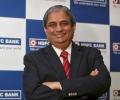
He said companies with a good strategy, technology, capital, liquidity and a motivated team will emerge as winners after the crisis.

Liquidity in the banking system has slipped into a deficit for the first time in three weeks, prompting banks to borrow the largest quantum of funds from the Reserve Bank of India (RBI) in around a month and a half. The key catalyst for the sudden tightening in liquidity was due to outflows on account of advance tax payments, which occur towards the end of a quarter. Analysts also cited other factors such as a currency leakage and possible interventions by the RBI in the foreign exchange market, which contributed to the tighter liquidity conditions.
With the rise in interest rates, bond yields have been on the rise; this will dent banks' treasury profits. Also, many retail borrowers may find it difficult to service their loans when the loan rates rise, points out Tamal Bandyopadhyay.

India's equity markets are on a roller-coaster ride, after delivering spectacular returns for two consecutive years - in 2020 and 2021. The benchmark National Stock Exchange's (NSE's) Nifty50 is down 1.5 per cent in the first nine months of the current calendar year 2022 (CY22) as foreign portfolio investors sold Indian stocks due to rising bond yields in the US and across global markets, including India. The sell-off in the Indian equity markets has, however, not been broad-based and largely limited to sectors facing earnings headwinds from rising interest rates, lower commodity and energy prices, and likely economic recession in advanced economies.

The electric scooter juggernaut which has been picking up momentum with heady growth month-on-month is now slowing down. The combined number of registrations in April of eight electric two wheeler companies has seen a dip of over 1 per cent to 43,061 vehicles, according to data from the Ministry of Road Transport & Highways' site VAHAN. The reasons are the continuing shortage of chips, especially after the Ukraine-Russia war, and the spate of fires which have led to scooters being recalled by manufacturers.
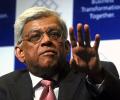
Noted banker Deepak Parekh on Thursday pitched for simpler corporate governance norms that focus more on trust than just compliance, saying economics and ethics are not trade-offs but complementary. Behind each financial crisis there is a governance failure but it is the entire system that gets impacted, because an eruption of a corporate or financial crisis almost always means a tightening of rules and regulations and increased compliance for all, he said. The HDFC chairman, who was addressing a seminar on corporate governance organised by former Sebi chairman M Damodaran's advocacy Excellence Enablers in Mumbai, stressed that the ultimate objective should be that corporate governance systems must become simpler and not more complicated.

Other gainers included Nestle India, Asian Paints, Bajaj Finance, NTPC, L&T, Axis Bank and Bajaj Auto. On the other hand, TCS, ONGC, Infosys, HDFC and SBI were among the laggards. NSE Nifty surged 121.65 points or 1.03 per cent to 11,889.40.

Infosys has emerged as the fastest growing IT services brand following 52 per cent brand value growth since last year and 80 per cent since 2020 to $12.8 billion, earning it third spot, the brand valuation consultancy said in its latest Global 500 IT Services Ranking report. TCS and Infosys have pushed IBM to fourth spot from second. IBM's brand value now stands at $10.6 billion, a decline of 34 per cent from last year and 50 per cent since 2020.

Tech Mahindra was the top laggard in the Sensex pack, cracking over 5 per cent, followed by Infosys, HDFC, IndusInd Bank, Reliance Industries and NTPC. On the other hand, Hero MotoCorp, L&T, Maruti, UltraTech Cement and Sun Pharma led the gainers' chart.

The regulatory changes brought in by the insurance regulator and the amendments proposed to the Insurance Act by the Centre may herald a new dawn for the sector in India. This may result in insurers bringing out more consumer-led products, top honchos of general insurance companies of the country concurred at the Business Standard BFSI Insight Summit 2022.
